Funky Fruits by Playtech hides a chain-reactor engine behind the friendliest face in the entire catalog. A grid of grinning cartoon produce conceals a progressive jackpot, cascading explosions, and a payout structure that punishes casual assumptions. What looks like a novelty release is actually a compounding machine: every detonation reshuffles the board, and each cherry cluster edges closer to a pot that never stops growing. This guide breaks down the mechanics, the full parameter chart, the symbol paytable, and the exact eight-cherry threshold that turns a modest spin into a jackpot event.
The Verdict: A below-average-RTP cluster game that compensates through cascading compound payouts and a single, bet-scaled progressive cherry jackpot. Built for jackpot chasers, not feature hunters.
Funky Fruits Parameters at a Glance
| Parameter | Value |
|---|---|
| Provider | 🎰 Playtech |
| Layout | Grid / Cluster Pays (5+ adjacent, horizontal & vertical) |
| RTP | 92.98% – 93.98% Below category avg |
| Volatility | High ⚡⚡⚡⚡⚡ |
| Max Win | Progressive Jackpot — seeds at 5,000× total bet, uncapped (fixed paytable max: 500× total bet) |
| Jackpot | Single Progressive (bet-percentage scaled: 10% / 20% / 50% / 100%) |
| Ante Bet | ❌ No Ante Bet option |
| Available Features | Chain Reactor Cascades · Cluster Pays · Multi-Symbol Parallel Scoring · Progressive Cherry Jackpot |
| Buy Feature | ❌ No "Buy Free Spins" / Buy game feature — all payouts route through the base grid loop |
| Min / Max Bet | Operator-dependent |
Symbol Paytable (× Total Bet)
Cherries are the only symbol that crosses into the progressive jackpot — at eight or more connected, fixed multipliers stop and the pot takes over. Values below are representative multipliers of your total bet.
| Symbol | 5 Symbols | 10 Symbols | 14 Symbols | 15+ Symbols |
|---|---|---|---|---|
| 🍒 Cherry (Top Premium) | 5× | 🏆 Progressive Jackpot | 🏆 Progressive Jackpot | 🏆 Progressive Jackpot |
| 🍋 Lemon — High Symbol | 0.75× | 15× | 120× | 500× (16+) |
| 🍊 Orange — Mid Symbol | 0.10× | 1.5× | 5× | 8× |
| 🍍 Pineapple — Mid Symbol | 0.10× | 1× | 3× | 5× |
| 🍇 Plum — Low Symbol | 0.08× | 0.50× | 1.2× | 1.5× |
| 🍉 Watermelon — Low Symbol | 0.04× | 0.25× | 0.60× | 0.75× |
Cherry fixed tiers before the jackpot: 5 cherries = 5×, 6 = 50×, 7 = 200×. At 8+ connected cherries, the payout switches to the progressive pot.
The Story Behind Funky Fruits: Sunshine Over a Loaded Grid
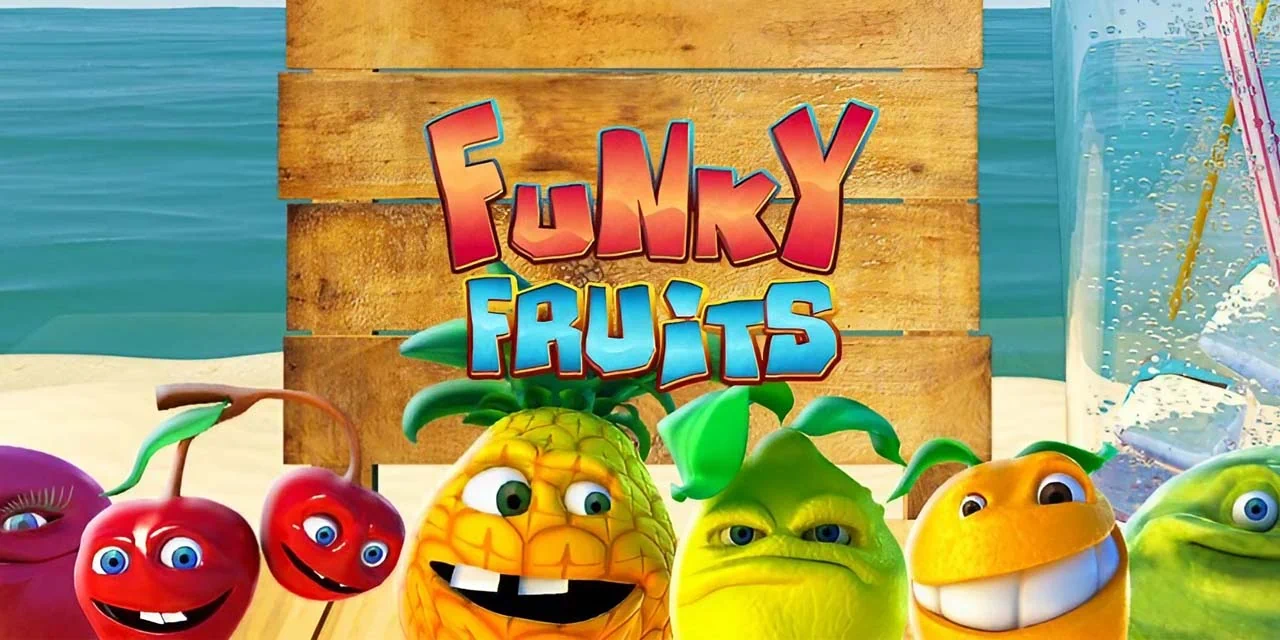
Funky Fruits sets its stage on a sun-drenched tropical beach, where six oversized, anthropomorphic fruits bob across a flat grid against pale sand and open sky. There is no villain, no quest, and no unlocking narrative — the theme is pure summertime escapism. Cherry reds, citrus oranges, and watermelon greens grin out at the player in a palette engineered to feel weightless and carefree. Yet that cheerful surface is a deliberate disguise. Beneath the beach-party charm sits a chain-reactor engine and a progressive jackpot that quietly compounds with every global spin. The fruits are not just characters; they are the moving parts of a machine that rewards patience over spectacle. The story Funky Fruits tells is a simple, seductive one: relax under the palm trees, watch the fruit tumble and shatter, and wait for eight cherries to line up and change everything.
Gameplay & Mechanics Analysis
Theme and Atmosphere
The visual register reads as deliberately lightweight, designed to camouflage the mechanical weight underneath. Spend twenty minutes in a session and the rhythm reveals itself: clusters form, detonate with a soft crunch, and fresh symbols cascade down with minimal fanfare. The audio stays restrained until a large chain fires and a subtle tempo shift signals the board reshuffling at speed. Among Playtech's catalog, Funky Fruits occupies a stripped-down niche — no bonus round, no free spins, no scatter — compressing its entire value proposition into a single loop: cascade, compound, and chase the progressive cherry pot.
- Chain-reactor cascades resolve multiple winning clusters in a single round at no additional cost, compounding payouts through consecutive grid reshuffles.
- Seven-cherry clusters pay a fixed 200× total bet — the highest fixed single-cluster payout before the progressive jackpot activates at the eight-cherry threshold.
- The progressive jackpot scales transparently from 10% to 100% of the pot by bet level, unlike random-tier jackpot alternatives.
- No bonus round, free-spin feature, or scatter mechanic — all payouts route through the same base grid loop, limiting session variety over extended play.
- Verified RTP of 92.98%–93.98% sits roughly three percentage points below the cluster-pays category average, a documented house-edge disadvantage.
Core Mechanic: How Cluster Pays Work
Funky Fruits awards wins when five or more identical fruit symbols sit adjacent horizontally or vertically. Diagonal connections do not count. All six symbol types — cherry, lemon, orange, pineapple, plum, and watermelon — are evaluated simultaneously on every board state. When a valid cluster registers, those symbols are removed instantly, remaining symbols drop to fill the gaps, and new symbols generate at the top of each column to refill the grid.
This cascade cycle repeats until no new winning clusters appear. What the paytable does not highlight is the multi-type resolution rule: because all six fruits resolve at once, a single cascade step often scores several small payouts together, and the combined value of three modest clusters frequently exceeds what one large cluster pays alone.
The Chain Reactor Cascade Sequence
Winning clusters flash, detonate, and vanish in one animation step; symbols above drop into the gaps and fresh symbols fill from the top. The game re-evaluates the entire grid after every drop — if a new valid combination forms, it detonates immediately and triggers another cascade. The loop continues until the grid stabilizes with no five-or-more cluster present, and every resolution costs nothing beyond your original bet. A round opening with a modest six-symbol plum cluster can spiral into four or five sequential detonations.
Multi-Symbol Parallel Scoring
After a cascade resolves, two or three different fruit types sometimes form valid clusters on the same board. The game scores every valid cluster at once before removing any symbols. If six lemons and five oranges cluster simultaneously, both payouts register before the grid drops — a double-pay event that, across extended sessions, drives a disproportionate share of total returns.
Cherry Accumulation Toward the Jackpot
Cherries form winning clusters at five or more like any other fruit. Below eight, fixed multipliers apply — 5× for five, 50× for six, 200× for seven — regardless of bet level or pot size. At eight or more connected cherries, the payout shifts from the fixed paytable to the progressive jackpot, awarding a percentage of the pot set by your bet level. This eight-cherry boundary is the single most consequential threshold in the game.
Jackpot Structure
| Bet Level | Jackpot Share | Effective Seed Payout |
|---|---|---|
| 🥉 Level 1 (Lowest) | 10% of pot | 500× total bet at seed |
| 🥈 Level 2 | 20% of pot | 1,000× total bet at seed |
| 🥇 Level 3 | 50% of pot | 2,500× total bet at seed |
| 👑 Level 4 (Maximum) | 100% of pot | 5,000× total bet at seed |
The pot seeds at 5,000× total bet and grows through a 1% contribution from every bet placed across all Funky Fruits sessions globally. Award selection is not random — your bet level determines your share before you play. This differs fundamentally from the random GRAND/MAJOR/MINOR/MINI structure used in most Playtech progressives. Only one player can win the progressive portion per reset cycle; because a cluster must form as one contiguous group, multiple separate cherry jackpots cannot trigger on a single board.
Volatility Profile and Who It's For
Volatility: High ⚡⚡⚡⚡⚡ · RTP: 92.98%–93.98% (verified from theoretical simulation data). The base game leans distinctly dry — many rounds produce no cluster at all, and those that do often yield sub-1× returns. Meaningful payouts concentrate in longer cascade chains and cherry events, creating sharp peaks against a flat baseline. Set a hard session floor and treat it as a boundary, not a guideline.
- Jackpot-focused players who accept lean base sessions in exchange for progressive upside and the possibility of one transformative cherry cluster.
- Risk-tolerant grinders who prefer a simple mechanical loop without feature complexity and understand that a sub-94% RTP redistributes value toward rare events.
Expert Edge: Pro Tips
The Escalation Principle. Cluster size grows non-linearly. A five-symbol watermelon cluster pays 0.04×; a twelve-symbol cluster of the same fruit pays 0.45× — a tenfold jump for roughly twice the symbols. The real escalation begins when cascades push a single type past the ten-symbol threshold, where values shift from incremental gains to category-jumping multipliers.
Bankroll Calibration. Given the 92.98% base RTP and cascade-dependent payout concentration, maintain a session bankroll of at least 200 spins at your chosen bet level to give the cascade engine a realistic window to compound.
Reading the Cascade in Real Time. A board showing multiple cherries scattered across the grid — even when not yet adjacent — signals elevated jackpot potential for the next cascade steps. A board that stabilizes early with mostly watermelons and plums tells you the round carries a low ceiling.
Frequently Asked Questions
How do you trigger the bonus in Funky Fruits?
Funky Fruits has no traditional bonus round or scatter trigger. Wins occur when five or more identical fruit symbols connect horizontally or vertically. Winning clusters explode and trigger a chain-reactor cascade that resolves additional wins automatically — the cascade sequence is the game's sole feature layer.
What is the RTP of Funky Fruits?
The verified minimum theoretical RTP is 92.98%, rising to 93.98% when the progressive jackpot contribution is included. This sits below the cluster-pays category average of roughly 96%, meaning a higher share of returns concentrates in rare cascade and jackpot events.
How does the jackpot work in Funky Fruits?
Eight or more cherry symbols must connect in a single adjacent cluster to trigger the progressive jackpot. Your bet level determines whether you receive 10%, 20%, 50%, or 100% of the pot. The pot seeds at 5,000× total bet and grows through a 1% contribution from every bet placed globally.
What is the maximum win in Funky Fruits?
The maximum fixed paytable award is 500× total bet for sixteen or more connected lemons. The progressive jackpot — seeding at 5,000× total bet and growing uncapped — represents the game's highest theoretical single-round payout. Cascade compounding can also stack multiple cluster wins within one round.
Can you retrigger the bonus in Funky Fruits?
Yes. The chain-reactor cascade retriggers automatically whenever new winning clusters form after a symbol drop. There is no cap on consecutive cascade steps within a single round, and each retrigger evaluates all six symbol types independently, so chains can shift between fruit types mid-sequence.
Final Verdict: Is Funky Fruits Worth Playing?
Funky Fruits by Playtech is a study in contrast — a carefree beach-party skin wrapped around one of the leaner RTP profiles in the cluster-pays category. Strip away the cheerful produce and you are left with a single, honest loop: cascade, compound, and hunt for eight connected cherries. There is no bonus buy, no Ante Bet, and no free-spin safety net, which means the entire experience lives or dies on the chain-reactor engine and the bet-scaled progressive pot. For players who value feature variety, the 92.98%–93.98% RTP and dry base game will feel punishing. But for jackpot-focused, risk-tolerant grinders who understand that value here concentrates in rare events, the transparent bet-level jackpot share and uncapped progressive upside offer a clear, high-volatility trade-off worth making — provided you set a firm session floor before the first spin.
Rating Breakdown
Independent scoring across six weighted dimensions